Did a revisit to Ned's Point Lighthouse, which is in a beautiful setting, no stamp here.


Two unrelated “uncles” bracket the
history of Ned’s Point Lighthouse. One, “Uncle Leonard,” played a key role in
the birth of the lighthouse; while the other, “Uncle Toby,” was a keeper there
just before automation.
Ned’s Point, located on Buzzard’s
Bay near the town of Mattapoisett, Massachusetts, takes its name from a former
owner of the land, Edwin “Ned” Dexter. Mattapoisett was settled in 1750 and
officially incorporated in 1857. There is evidence of Wampanoag Indian
settlements, including burial grounds, throughout the town, and, in fact, the
word Mattapoisett is Wampanoag for “a place of resting.”
Early industry included logging and
farming, but Mattapoisett became best known as a center for shipbuilding and
whaling. Some 400 ships were built in the town's shipyards from 1740 until the
1870s, including the Acushnet, the ship that Moby Dick author Herman
Melville sailed on and later deserted. The town supplied many of the whalers
used on the East Coast in the first half of the nineteenth century. The last
one, the Wanderer, was built in 1878, shortly after the discovery of oil
in Pennsylvania.
It was in 1837, during
Mattapoisett’s run as a significant shipbuilding harbor, that Ned’s Point
became home to a lighthouse after Congressman (and ex-president) John Quincy
Adams helped convince Congress to approve $5,000 for the project.
The government paid $240 for the
four-acre site to H.H. Edwards, through his guardian Barnabus Hiller. The
contract to build the tower and keeper’s dwelling went to a local businessman
by the name of Leonard “Uncle Leonard” Hammond. Given the shameful results of
his efforts, he can hardly be considered a benevolent uncle.
When construction fell behind
schedule and an inspector showed up in town, Uncle Leonard hustled the man off
to another of his businesses—a tavern—while his flustered crew flew about to
make the project appear completed. In lieu of proper floor in the tower, they
balanced wooden planks over barrels. When Uncle Leonard and the inspector
arrived, the inspector put one foot on the end of a loose board, which
immediately flew out from under him, rudely depositing the man unhurt, but
furious, in the foundation.
Beach rubble was used to build the
35-foot stone tower, which featured a cantilevered, mortar-less, granite
staircase that led up to a cast-iron “birdcage” lantern room. While Uncle
Leonard’s avarice, lack of skill, or the struggle to meet tight financial and
time constraints led to the deplorable conditions at the lighthouse, it was the
keepers who for years afterwards paid the price for the shoddy work. Most of
the early keepers at Ned’s Point remained only a few years, until the 20-year
split term of the former stage coach driver Larnet Hall, Jr. (1848-1853 and
1859-1874).
The light’s terrible state was
recorded in 1838 by Lighthouse Inspector Carpender just a few months after the
activation of the light in March: “The keeper informs me that, in the late
storm, both buildings leaked in all directions. The unskilfulness of the work
extended to the lantern, the dome of which likewise leaked, rendering it
prudent for the keeper to remain by the lamps during the rain, lest the light
should become extinguished. I removed the surface of the mortar or cement, in
several places, and found the stone to be laid in what appeared to be little
more than mere sand. The glazing of the lantern was to have been of Boston
double-crown glass, but evidently glass of the thinnest kind has been used, the
quality of which is nothing more than ordinary. I found the lantern to be only
five feet eight inches high, which is too low, again, for the convenience of
the keeper with his hat on….”
Carpender recommended that the
light’s eleven lamps be reduced to four, which would save some of the 300 to
400 gallons of oil burned annually. Three of the eleven lamps were even
reflecting their light inland.
In winter, keepers would haul
weighty buckets of whale oil from the oil house, sometimes in
gale force storms, to warm it on the stove on the lighthouse’s ground level.
From there, they would lug the oil up the thirty-two stone steps to the lantern
room, where they were kept busy trimming and tending the wick to keep the
beacon burning bright through the night.
Many stories about the Ned’s Point
Lighthouse reveal not only the harsh life of the keeper, but also that of his
wife, who would often tend vegetable plots and animals to supplement their food
supply. When the keeper was ill, his wife would often have to take over his
duties as well.
An 1850 inspection report called the
state of the lighthouse “second to none,” while the following year it was
described as poorly constructed, leaky, and with a poor lighting system. That
reversal may reflect the Federal Government’s widespread investigation of
lighthouses by military officers and civilian scientists in 1851. For thirty
years, lighthouses had fallen under the review of the tightfisted Treasury
Department auditor Stephen Pleasanton, which was believed to have resulted in
America’s lights being some of the worst in the world. Complaints and the
resultant audit inspired the formation of the Lighthouse Board.
In 1857, the tower at Ned’s Point
received a fifth-order Fresnel lens, but it was not until 1868-69 that
substantial renovations to the keeper’s house were undertaken.
By 1878 a new tower was requested.
The cost for the tower and general repairs to the keeper’s dwelling was
estimated at $5,000. A repeat request was submitted in 1879, but it was not
until 1888, following its destruction by a hurricane, that the original stone
house was demolished and a frame house erected on the foundation. The present
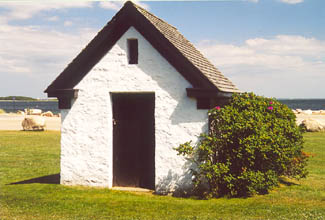
lantern room was installed in 1896, and a brick oil house was constructed in
1907.
Following seventeen years as keeper
of the Bird Island Lighthouse (which required rowing out to the island),
advancing age and poor health prompted Zimri Tobias “Uncle Toby” Robinson to
transfer to Ned’s Point in 1912. Along with the transfer came a $50 salary cut
to $600 a year. After Toby suffered a stroke, Jerry Robinson assumed the bulk
of the work until Toby died in 1914. He was followed by Russell B. Eastman, the
final keeper.
When the light was fully automated
in 1923, the keeper’s house was loaded onto the scow Eva and floated
across Buzzard’s Bay to the Wing’s Neck Lighthouse in Bourne, where it remains
as a private residence. Rumor holds that Eastman remained inside the house
cooking his breakfast as it floated across the bay.
When the Coast Guard decommissioned
the light in 1952, an error put the thirty-five-foot, cone-shaped, whitewashed
stone lighthouse up for sale “to the lowest bidder.” So as not to be underbid,
James Stowell of Mattapoisett quickly entered his bid of one cent. Eight pages
of explanation from the government were sent to Stowell with the news that the
sale was canceled.
The majority of the lighthouse
grounds, with the exception of the lighthouse itself, was sold to the town of
Mattapoisett in 1958. The light was reactivated in 1961 with a new modern lens
having a six-second isophase characteristic - a white light on for three
seconds, alternating with three seconds of darkness.
Next was a new marker/memorial, to the shipbuilders of Mattapoisett:


Commemorating Mattapoisett’s Shipbuilders From the year 1752 to 1876, at least six shipyards flourished along this waterfront from the foot of Pearl Street to Ship Street (Cannonville). The fine harbor, an abundant supply of virgin timber and a ready market for whaling and maritime commerce attracted the finest of shipbuilders. Barks, brigs, schooners, sloops, and merchant ships were built and launched here. When the whaling industry was at its height in New Bedford, Mattapoisett became world famous for its whaleships. More than 350 vessels went down the ways during this period. Among the most famous were: “Acushnet” ship 1840 which carried as a crew member Herman Melville on her maiden voyage. Ten years later he wrote the famous whaling saga “Moby Dick” “Platina “ship 1847 distinguished for capturing a white whale “Wanderee” Bark 1876 Last whaleship to be built in Mattapoisett Yards, and one of the last whalers to sail from New Bedford Mattapoisett Bicentennial Committee 1976
Next, a roadside oddity, a giant Seahorse statue which is all that is left of the Sea Horse Gift Shop, which was torn down a long while ago:

There was just one National Register Site in town, the Third Meetinghouse, at 1 Fairhaven Road:

The Third Meetinghouse is an historic meeting house and Grange Hall at 1 Fairhaven Road in Mattapoisett, Massachusetts. The Third meeting house of the Second Parish was built in 1816.The Second Parish of Rochester, which met in the building, was founded around 1736 and met in two prior meeting houses before the Third Meeting House was constructed. After 1870 the meeting house became the Barstow School The building was added to the National Register of Historic Places in 1976

No comments:
Post a Comment