Showing posts with label May 2017 South Carolina. Show all posts

Wednesday, May 31, 2017

May 31st Raining!

The promised and predicted rainstorms came, steady rain for most of the night.


Went to check on the propane tank, no information, then Wal Mart for provisions, then Master's RV to see about scheduling the RV to button it up.  Then can take it tomorrow and hopefully squeeze it in.  Then to Office Max, so Bette could get her a new computer.  Got a Dell. 
 
Saw this plate while we were out:


Tomorrow will be another wasted day:  Take the RV to be checked, stop at Wal Mart for a prescription fill, check on the propane. 
 
 
Closed out the license plates for the month, not a bad one.  Got 49/51 of US plates, missing Hawaii and North Dakota.
 
 
Got 6 Canadian Provinces this month as well:


Tuesday, May 30, 2017

May 30th On to Greenwood, and the Propane issue and then wreck #3.

Trip started out ok, ended badly. 


Tale of the Garmin:

221.8 miles, 6:22 total time, with delay for wreck and propane tank work.
4:48 moving time.  Max speed 71

Went to Wal Mart first to unhook, and that turned out to be a bad thing.

As I was leaving to go to the hardware store, where the propane repairs were to take place, I bashed the coach, got another three doors. Did it trying to make a turn out from the parking lot.  Plan is to take it to Masters RV here in town to see if they can pretty it up to get on the road.  More tomorrow.


On the other hand, we were successful at getting the tank removed from the coach to start the propane repair.  Was a bit of a challenge, involving removing doors, but they are confident they can do the repair. 

Leaving Saddle Hill in a bit to go to Chili's for dinner.  Then to Wal Mart to return Bette's computer. 

Tomorrow will be involved in coach repairs-  Masters first, then the Triangle Hardware for propane repair.  Day lost.  

Did see this plate on the way up:


Had nice weather today.....


Monday, May 29, 2017

May 29th Happy Memorial Day...

Going to be a hot one here, for sure.. already almost 80 before 6am!


Not much on the plate today, just some loose end things- then in the morning, we head to Greenwood for 5 nights before we head to Charlotte for the night to catch the plane to Phoenix. 

Sunday, May 28, 2017

May 28th Over to Parris Island

Went over to Parris Island this morning, first stop was by the old house, met the CG's daughter, Chloe- nice young lady. 


Then drove out to the golf course, and to the Santa Elena Historical Site:

Saw several markers, but the trail had recent storm damage, so I missed a few:


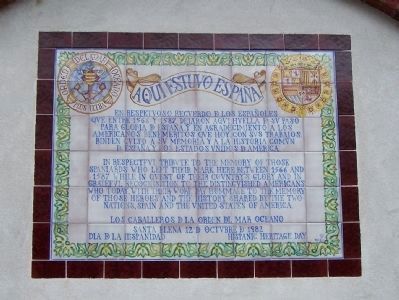
Aqui Estuvo España (Here Was Spain)


Aqui Estuvo España Marker image. Click for full size.
By Mike Stroud, June 26, 2009

1. Aqui Estuvo España Marker
Inscription. En respetuoso recuerdo de los Españoles que entre 1566 y 1587 dejaron aqui huella de su paso para gloria de España, y en agradecimiento a los Americanos benemeritos que hoy, con su trabaios rinden culto a su memoriay a la historia comun de España y los Estados Unidos de América.

In respectful tribute to the memory of those Spaniards who left their mark here between 1566 and 1587 while in quest of their country's glory and in grateful recognition to the distinguished Americans who today, with their work pay homage to the memory of those heroes and the history shared by the two nations, Spain and the United States of America.

Los Caballeros de la Orden del Mar Oceano Santa Elana 12 de Octubre de 1982
Dia de la Hispandid — Hispanic Heritage Day

And this one, next to it:

Northern Most Known Bastion of Spanish Florida


Northern Most Known Bastion of Spanish Florida Marker image. Click for full size.
 

1. Northern Most Known Bastion of Spanish Florida Marker
Inscription. Less than three decades after Columbus had discovered America, on Aug. 18, 1521 ( St. Helena's Day ), Spanish seafarers from Santo Domingo sighted this magnificent harbor, named its Eastern headland the Punta de Santa Elena, from which the area derived its name, and claimed it for the King of Spain. For nearly half a century this was the mecca of Spain's repeatedly frustrated efforts to plant a settlement on the Atlantic Coast, Not however until after Ribaut's garrison had abandoned Charlesfort, at what he had called Port Royal, did Menéndez de Avilés arrive to prevent further incursions by the French, to assert Spanish sovereignty, and to Christianize the natives. Dispatched by Phillip II of Spain in 1565 with a fleet of vessels and over 2500 colonists, he had made his landfall at Cape Canaveral, expelled the French from Fort Caroline on the River May, established and fortified St. Augustine, and wreaked vengeance on the returning Rebault. In the summer of 1567 he proceeded to Santa Elena, apparently his original destination; here he planted Fort San Felipe, the northernmost known bastion of the province of Florida and built the city planned for its development.

For twenty years Spain's tenure was marked by varying degrees of success, marred by disintegrating relations with the Indians, who destroyed the Fort and the settlement
in 1577. The fortress was promptly replaced by Fort San Marcos, its palisades made of cedar logs brought from St. Augustine; but the settlement remained in ashes until 1580 when it was rebuilt to its former condition - - some sixty odd buildings, half of which were tabby. Partially governed by its inhabitants, it furnished what was possibly the first instance of the use of the democratic process, and of woman suffrage in the New World.

Both the Fort and the settlement were abandoned in 1587 when the inhabitants were withdrawn to St. Augustine to strengthen its defenses following Sir Francis Drake's raid of the previous year.

On way back we stopped in Port Royal for 2 NRHP sites:

The F.W. Scheper Store building

Mt Union Church, which had a National Register plaque on it.

Also stopped in at Brick Baptist Church which is part of Penn Center, and got these shots


An old water tower


Perhaps an old parsonage building
An old bike, probably the main form of transportation at Penn Center


                       Left over from yesterday, the Verdier House Downtown.


Saw these plates as well:


Saturday, May 27, 2017

May 27th To Beaufort, Farmer's market, then Lunch with Jane, then dinner tonight with Barry & Kerry Johnson

Got up early, then headed to Jane's about 1015 to head to the Farmer's Market. 
Then over to the Red Rooster Café for Lunch.  had to wait about an hour for the food to come-

Back at the coach to rest, then tonight, down to Bluffton for dinner with the Johnsons.  We went to the Bluffton Seafood Company, a local famous place to eat, and waited for 35 min to get a seat, then a leisurely dinner.  Great to see the Johnsons again. 

On the way to Jane's saw these two markers

Mather School


Mather School Marker image. Click for full size.
 
1. Mather School Marker
Inscription. Shortly after the Civil War, Mather School was founded here by Rachel Crane Mather of Boston. In 1882 the Women's American Baptist Home Mission Society assumed support of the venture, operating it as a normal school for black girls. With some changes, the school continued until 1968, when it was closed and sold to the state for the educational benefit of all races.

And this one:

                                  Beaufort


Beaufort Marker, now a new location image. Click for full size.
 
1. Beaufort Marker, now a new location
( pronounced "byew-furt" )
Inscription.
Second oldest town in South Carolina,
Authorized by the Lords Proprietors,
December 20, 1710,
Chartered January 17, 1711,
Laid out prior to February 16, 1717,
Incorporated by the state,
December 17, 1808
 
 
We planned tomorrow to visit with Kathy Caine, but she texted us to say that she wasn't feeling too well, and would not be down.  So I reckon we'll just head over to Parris Island just the two of us. 


Friday, May 26, 2017

May 26th Gullah Festival today......

Woke up to coolish temps!


This morning, will do some NRHP sites on St Helena, then head on down to Chambers Waterfront Park for some displays for the Gullah Festival. 

Did these sites this morning early:

Chapel of Ease


Chapel of Ease Marker image. Click for full size. 
1. Chapel of Ease Marker
Inscription. To St. Helena's Church, Beaufort, S.C. Built about 1740. Made a separate church after the revolution. Burned by forest fire Feb. 22, 1886.

The burned out chapel. 


Fripp Mausoleum

The Corner Store and Office in Frogmore

The Green in Frogmore


                                                             Tombee Plantation


At around 1030 we headed downtown to check out the scene at the Gullah- Geechee festival down at Chambers Park.  It was pretty much a bust- didn't see anything we really liked.   Shopped for a bit on Bay street, then to McDonalds on the Island for a quick lunch, then Wal Mart.  Got Bette a new laptop computer, since she wasn't happy with hers, and 44.00 worth of provisions. 
 
Saw these plates today: plus an Alaska plate!  2nd day in a row. 


Will now rest up and plan next couple of days.  Rendezvous with Jane Fender tomorrow, and then dinner with the Johnsons tomorrow evening down in Bluffton.  


Thursday, May 25, 2017

May 25th Doing Beaufort

Did several stops in Beaufort and St Helena Island today.

First, got my 298th National Park, the Reconstruction Era NM, which had 2 stamps and 2 visitor centers...

First was Penn Center,


Also the Beaufort Arsenal for a stamp:


Also, several National Register of Historic places sites:


There was also a marker at the Beaufort Arsenal...
 

Beaufort Arsenal


Beaufort Arsenal Marker image. Click for full size.
1. Beaufort Arsenal Marker
Inscription. Erected in 1798 and rebuilt in 1852, the Beaufort Arsenal was the home of the Beaufort Volunteer Artillery, commissioned in 1802, which had its roots in an earlier company organized in 1776 and served valiantly in the Revolutionary War. The BVA was stationed at Fort Beauregard during the Battle of Port Royal on November 7, 1861.
 
The "Secession House"
 

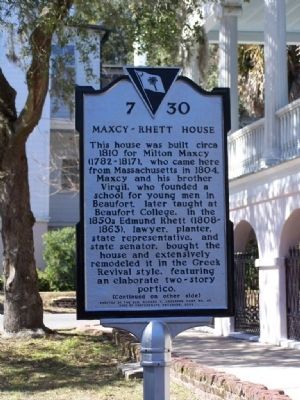
Maxcy - Rhett House / “Secession House”
 
 
Maxcy Rhett House Marker image. Click for full size.
 

1. Maxcy Rhett House Marker
Inscription.
Maxcy - Rhett House
This house was built circa 1810 for Milton Maxcy (1782-1817), who came here from Massachusetts in 1804. Maxcy and his brother Virgil, who founded a school for young men in Beaufort, later taught at Beaufort College. In the 1850's Edmund Rhett (1808-1863), lawyer, planter, state representative, and state senator, brought the house and extensively remodeled it in the Greek Revival style, featuring an elaborate two-story portico.
"Secession House"
Edmund Rhett, along with his brother Robert Barnwell Rhett (1800-1876), lawyer, state representative, state attorney general, U.S. congressman and senator, was an outspoken champion of state rights and Southern nationalism from the 1830's to the Civil War. This house, long known as "Secession House," was the scene of many informal discussions and formal meetings during the 1850's by the Rhetts and their allies advocating secession and Southern independence. 
 
One for local hero Robert Smalls as well:
 

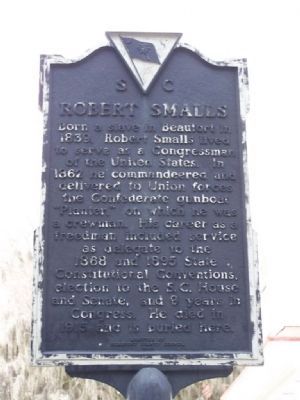
Robert Smalls
 
 
Robert Smalls Marker image. Click for full size.
 

1. Robert Smalls Marker
Inscription. Born a slave in 1839, Robert Smalls lived to serve as a Congressman of the United States. In 1862 he commandeered and delivered to Union forces the Confederate gunboat Planter, on which he was a crewman. His career as a freedman included service as a delegate to the 1868 and 1895 State Constitutional Conventions, election to the SC House and Senate and nine years in Congress. He died in 1915 and is buried here.
 
A couple at Penn School:

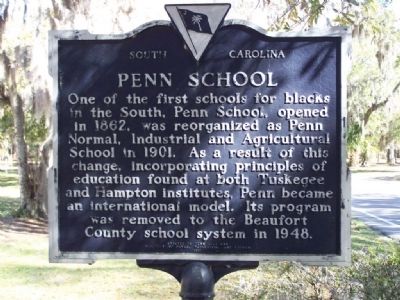
Penn School
 
 
Penn School Marker image. Click for full size.
 

1. Penn School Marker
Inscription. [front text]
One of the first schools for blacks in the South, Penn School, was reorganized as Penn Normal, Industrial and Agricultural School in 1901. As a result of this change, incorporating principals of education found at both Tuskegee and Hampton Institutes, Penn became an international model. Its program was removed to the Beaufort County school system in 1948.

[back text]
After Union occupation of the sea islands in 1861, two northerners, Laura Towne and Ellen Murray, came to assist the freed blacks of the area establishing Penn School here in 1862. The earliest known black teacher was Charlotte Forten, who traveled all the way from Massachusetts to help her people.
 
And this one, about a hurricane:
 

The Great Sea Island Storm


The Great Sea Island Storm Marker image. Click for full size.
 

1. The Great Sea Island Storm Marker
Inscription. ( Front text )
On the night of August 27, 1893, a huge "tropical cyclone," the largest and most powerful storm to hit S.C. until Hurricane Hugo in 1989, made landfall just E of Savannah, Ga. With gusts as high as 120 mph and a storm surge as 12 ft., the worst of the storm struck the Sea Islands near Beaufort - St. Helena, Hilton Head, Daufuskie, Parris and smaller islands were devastated.
(Continued on other side)

(Reverse text )
The storm killed more than 2,000 and left more than 70,000 destitute in coastal S.C. and Ga. Losses in lives and property were most catastrophic among blacks who were former slaves or their descendants. Clara Barton and the American Red Cross launched a massive relief effort, the first after a hurricane in U.S. history. Donations in 1893-94 fed, clothed, and sheltered thousands.


First African Baptist Church
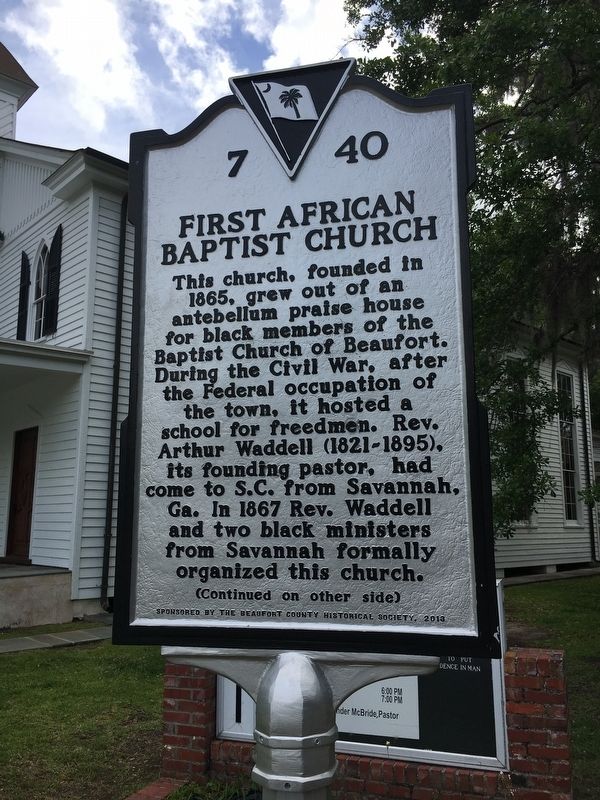
 
 
First African Baptist Church Marker image. Click for full size.
 

1. First African Baptist Church Marker
Inscription. This church, founded in 1865, grew out of an antebellum praise house for black members of the Baptist Church of Beaufort. During the Civil War, after the Federal occupation of the town, it hosted a school for freedmen. Rev. Arthur Waddell (1821-1895), its founding pastor, had come to S.C. from Savannah, Ga. In 1867 Rev. Waddell and two black ministers from Savannah formally organized this church. In 1885 the congregation, with more than 900 members, built this "handsome and commodious" Carpenter Gothic church. Rev. Waddell continued to serve this church until he retired in 1894. At his death in 1895 First African Baptist was described as "one of the most aristocratic colored churches." Robert Smalls (1839-1915), Civil War hero, state legislator, and U.S. Congressman, was its most prominent member.


On the way home, got stopped by the Lady's Island Bridge opening- it seems the bridge isn't working too well.  Took several minutes to close.