First, got my 298th National Park, the Reconstruction Era NM, which had 2 stamps and 2 visitor centers...
First was Penn Center,


Also the Beaufort Arsenal for a stamp:


Also, several National Register of Historic places sites:


There was also a marker at the Beaufort Arsenal...
Beaufort Arsenal

1. Beaufort Arsenal Marker
Inscription. Erected in 1798 and rebuilt in 1852, the Beaufort Arsenal was the home of the Beaufort Volunteer Artillery, commissioned in 1802, which had its roots in an earlier company organized in 1776 and served valiantly in the Revolutionary War. The BVA was stationed at Fort Beauregard during the Battle of Port Royal on November 7, 1861.
The "Secession House"
Maxcy - Rhett House / “Secession House”
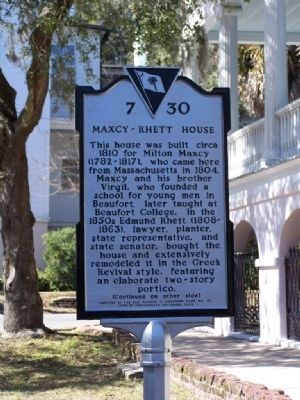
1. Maxcy Rhett House Marker
Inscription.
This house was built circa 1810 for Milton Maxcy (1782-1817), who came here from Massachusetts in 1804. Maxcy and his brother Virgil, who founded a school for young men in Beaufort, later taught at Beaufort College. In the 1850's Edmund Rhett (1808-1863), lawyer, planter, state representative, and state senator, brought the house and extensively remodeled it in the Greek Revival style, featuring an elaborate two-story portico.
Edmund Rhett, along with his brother Robert Barnwell Rhett (1800-1876), lawyer, state representative, state attorney general, U.S. congressman and senator, was an outspoken champion of state rights and Southern nationalism from the 1830's to the Civil War. This house, long known as "Secession House," was the scene of many informal discussions and formal meetings during the 1850's by the Rhetts and their allies advocating secession and Southern independence.
One for local hero Robert Smalls as well:
Robert Smalls
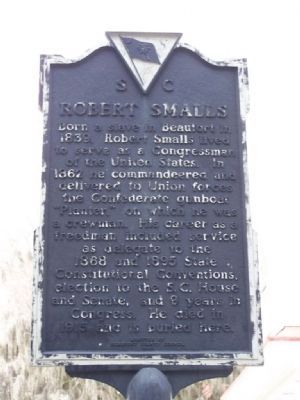
1. Robert Smalls Marker
Inscription. Born a slave in 1839, Robert Smalls lived to serve as a Congressman of the United States. In 1862 he commandeered and delivered to Union forces the Confederate gunboat Planter, on which he was a crewman. His career as a freedman included service as a delegate to the 1868 and 1895 State Constitutional Conventions, election to the SC House and Senate and nine years in Congress. He died in 1915 and is buried here.
A couple at Penn School:
Penn School
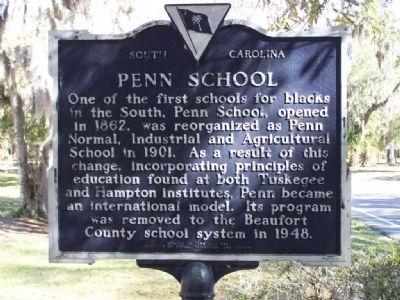
1. Penn School Marker
Inscription. [front text]
One of the first schools for blacks in the South, Penn School, was reorganized as Penn Normal, Industrial and Agricultural School in 1901. As a result of this change, incorporating principals of education found at both Tuskegee and Hampton Institutes, Penn became an international model. Its program was removed to the Beaufort County school system in 1948. [back text]
After Union occupation of the sea islands in 1861, two northerners, Laura Towne and Ellen Murray, came to assist the freed blacks of the area establishing Penn School here in 1862. The earliest known black teacher was Charlotte Forten, who traveled all the way from Massachusetts to help her people.
And this one, about a hurricane:
The Great Sea Island Storm

1. The Great Sea Island Storm Marker
Inscription. ( Front text )
On the night of August 27, 1893, a huge "tropical cyclone," the largest and most powerful storm to hit S.C. until Hurricane Hugo in 1989, made landfall just E of Savannah, Ga. With gusts as high as 120 mph and a storm surge as 12 ft., the worst of the storm struck the Sea Islands near Beaufort - St. Helena, Hilton Head, Daufuskie, Parris and smaller islands were devastated.(Continued on other side)
(Reverse text )
The storm killed more than 2,000 and left more than 70,000 destitute in coastal S.C. and Ga. Losses in lives and property were most catastrophic among blacks who were former slaves or their descendants. Clara Barton and the American Red Cross launched a massive relief effort, the first after a hurricane in U.S. history. Donations in 1893-94 fed, clothed, and sheltered thousands.
First African Baptist Church
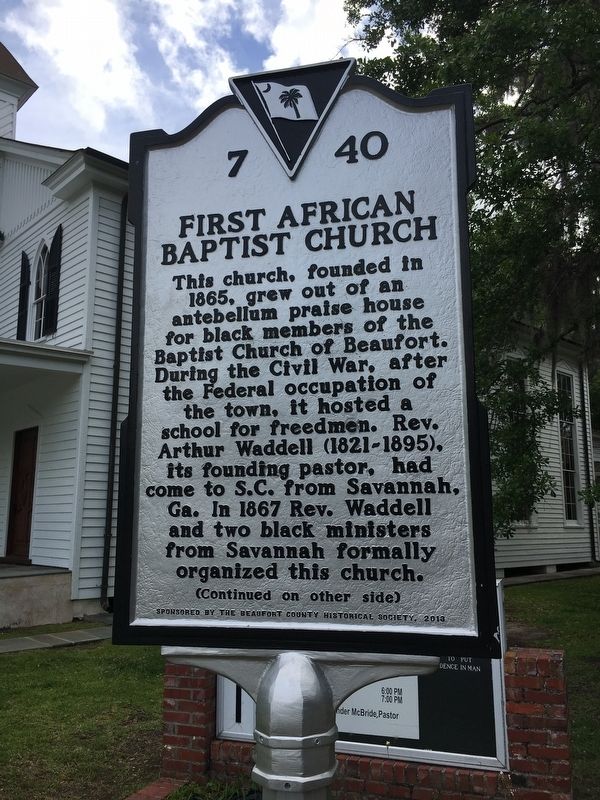
1. First African Baptist Church Marker
On the way home, got stopped by the Lady's Island Bridge opening- it seems the bridge isn't working too well. Took several minutes to close.


No comments:
Post a Comment